

Could chemicals in your indoor air be affecting the health of your home?
Volatile Organic Compounds, commonly known as VOCs, are chemicals that can be released into indoor air from building materials, furnishings and everyday household products. Potential sources include paints, adhesives, cabinetry, flooring, composite timber products, furniture, cleaning products, fragrances, varnishes and recently installed finishes.
Formaldehyde is a specific VOC frequently associated with pressed-wood products such as MDF, particleboard and plywood, as well as some adhesives, textiles, furnishings and building products. Chemical emissions may be particularly noticeable in new homes, recently renovated buildings or spaces containing newly installed cabinetry, flooring or furniture.
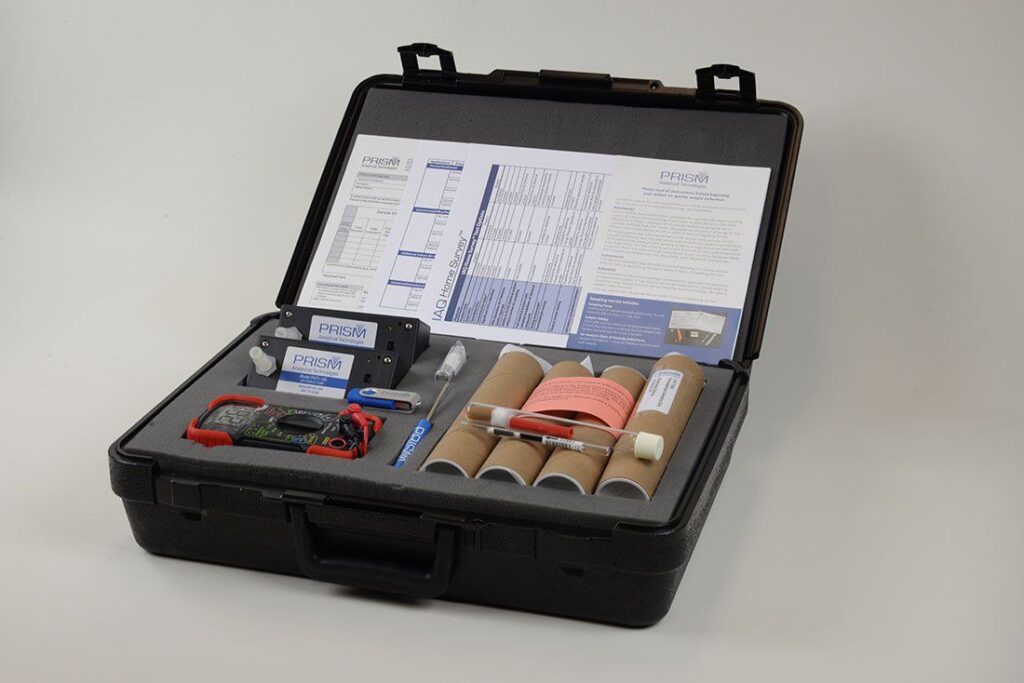
At Healthy Home Biology, we investigate the building as a whole—considering the materials present, recent renovations, ventilation, temperature, humidity, occupant concerns and possible sources of chemical off-gassing.
When may VOC testing be helpful?
VOC and formaldehyde testing may be considered when:
- there is a persistent chemical, paint-like or “new building” odour
- a home has recently been built or renovated
- new cabinetry, flooring, furniture or finishes have been installed
- symptoms appear to be more noticeable inside a particular building or room
- occupants feel better when away from the property
- there are concerns about inadequate ventilation or chemical accumulation
- a specific product or building material is suspected of off-gassing
- further information is needed before selecting remediation or ventilation strategies
Indoor air quality concerns can be influenced by the type and quantity of pollutants present, the rate at which they are released and the amount of ventilation available to remove them. Symptoms associated with poor indoor air quality are often non-specific, so testing should be interpreted alongside the building history and environmental conditions rather than viewed in isolation.
Our building biology approach
Before recommending testing, we first gather information about the property and the concern being investigated. This may include:
- the age and construction of the building
- recent painting, renovations or installation of new materials
- cabinetry, flooring, furniture and composite timber products
- cleaning products, fragrances and other household chemicals
- heating, cooling and ventilation systems
- when and where odours or symptoms are most noticeable
- relevant product information or Safety Data Sheets
Understanding the likely source is important because there is no single air test that identifies every possible chemical. The most appropriate testing method will depend on the suspected pollutant and the purpose of the investigation.
Real-time VOC screening
Direct-reading VOC equipment can provide an immediate indication of the overall level of detectable VOCs within a space. This can be useful for:
- comparing different rooms or areas
- observing changes in VOC levels over time
- identifying areas with comparatively elevated readings
- investigating possible off-gassing from particular materials or furnishings
- assessing how ventilation influences indoor concentrations
However, general VOC screening does not normally identify each individual chemical present. A reading represents a combined response to detectable compounds and should be treated as a screening and investigative tool, rather than a complete chemical analysis.
Laboratory VOC testing
Where identification and more accurate quantification are required, air can be collected using a calibrated sampling pump and appropriate sorbent media.
A measured volume of air is drawn through the sampling tube at a specified flow rate. The sample is then submitted to a specialist laboratory for analysis. Depending on the sampling method selected, laboratory testing may identify individual VOCs and report their measured concentrations.
This type of testing can provide more detailed information about chemicals potentially being released from:
- paints, coatings and varnishes
- adhesives, sealants and resins
- engineered timber and cabinetry
- flooring and floor finishes
- furniture and furnishings
- cleaning and personal-care products
- printing, craft or occupational materials
The selection of sampling media is important because different methods are designed to collect different groups of chemicals. International sampling methods for indoor VOCs commonly use sorbent tubes followed by laboratory analysis.
Formaldehyde testing
Although formaldehyde is a VOC, it generally requires a formaldehyde-specific sampling method rather than relying solely on a general TVOC reading.
Portable formaldehyde sensors can be affected by other gases and environmental conditions. Where an accurate indoor concentration is required, formaldehyde can be collected using specialised treated sampling media and submitted for laboratory analysis.
A commonly recognised laboratory method captures formaldehyde on DNPH-treated media before analysis. This provides a more selective measurement than broad VOC screening alone.
What may be included in an assessment?
Depending on the property and your concerns, an assessment may include:
- a pre-assessment questionnaire and discussion
- review of recent building or renovation work
- identification of likely chemical sources
- review of relevant product information or Safety Data Sheets
- room-by-room VOC screening
- temperature and relative-humidity measurements
- assessment of ventilation and air movement
- targeted formaldehyde or VOC air sampling
- specialist laboratory analysis where required
- interpretation of the findings within the context of the building
- practical recommendations to reduce exposure and improve indoor air quality
Recommendations may include source removal or isolation, changes to product use, increased ventilation, mechanical ventilation options, material replacement or further targeted investigation.
Understanding the results
VOC testing is most valuable when the results are considered together with:
- the building materials and furnishings present
- temperature and relative humidity
- ventilation conditions
- recent activities inside the property
- the duration and location of sampling
- outdoor or background influences
- occupant observations and symptom patterns
Australia does not currently have a complete set of enforceable residential indoor-air standards covering every VOC. Workplace exposure standards are designed for occupational environments and should not automatically be treated as residential health targets. Results therefore need to be interpreted carefully using suitable health-based guidance, laboratory reference information and the individual building context.
Healthy Home Biology does not diagnose medical conditions. Our role is to investigate the indoor environment, identify potential sources of exposure and provide practical, evidence-informed recommendations for improving indoor conditions.
Concerned about chemical off-gassing?
Every property and chemical concern is different. A brief initial discussion can help determine whether general VOC screening, formaldehyde testing, targeted laboratory analysis or a broader indoor-air-quality assessment is the most appropriate next step.
Contact Healthy Home Biology to discuss VOC and formaldehyde testing for your home or workplace.